
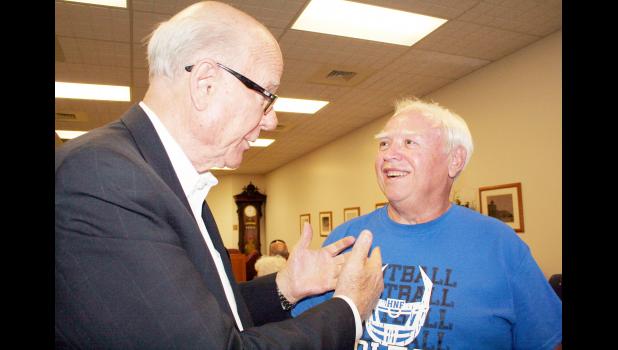
HHS alum Pat Roberts returns to talk agriculture, other topics

In spite of presidential election year politics, the need for immigration reform and discussions over how to fight terrorism and the Zika virus, U.S. Senator and Holton High School alumnus Pat Roberts reminded a group of Holton-area residents on Thursday that his primary focus remains agriculture.
Roberts visited with more than 40 area residents during a “town hall” meeting held that morning in Holton City Hall, touching on a variety of topics but reminding those present that above all, doing whatever is possible to remain a world leader in agriculture is still “my primary obligation and my responsibility.”
During his hour-long visit, Roberts — who currently chairs the Senate Agriculture Committee and has also served in the same position while on the House Agriculture Committee — expressed concern with a proposal from Vermont to put labels on food going into the state. The big problem there, he said, was Vermont’s concern over “genetically modified food.”
“We certainly don’t want one state trying to dictate what everybody else can buy in the grocery stores,” Roberts said, noting that if Vermont’s proposal had gone through, it would have made purchasing food more expensive for the vast majority of the country.
Roberts also said that states like Vermont are getting worked up over “genetically modified food,” when they should be doing what they can to promote “agriculture biotechnology” and helping farmers benefit from “the tremendous progress we’re making” in this field.
“This has been probably the most important issue in agriculture for 20 years. Do you go ahead with agriculture biotech that enables us to feed a troubled and hungry world with 8.5 billion people, or do you just stay put? You don’t stay put,” he said.
And, Roberts added, it is “absolutely imperative” that farmers and ranchers not “stay put” when it comes to providing “the best possible food at the lowest price in the history of the world.” More than 1,200 different farm and ranch advocacy groups agree, he said, despite protests from the “organic food industry.”
Farmers and ranchers across the country are also dealing with federal cuts in the crop insurance program, Roberts said, adding that despite $6 billion in cuts from the $9 billion-a-year program, legislators restored another $3 billion. He added that he and House Agriculture Committee Chairman Mike Conaway have “stood firm” on not allowing any more to be cut from the program.
Another agriculturally-based issue involves a child nutrition bill that “passed out of committee” and is expected to go before the full Senate in September, Roberts said. He reminded those present that his research on the bill included visits to 10 different Kansas school districts — including Holton — to sample what students are getting for lunch and express his concern that about one-third of food in school lunch programs is being wasted.
“This bill gives more flexibility to the school nutritionist, so she or he can make a decision as to what foods the kids will eat and still be healthy foods,” he said. “I think that decision should rest at least in part with the school nutritionists, and we’re trying to reduce the paperwork for them.”
Agriculture is not the only issue on Roberts’ plate, he said. There’s the matter of tax reform, and he noted that comprehensive tax reforms have not been passed by Congress in about 30 years, with no significant action expected until after this year’s presidential election.
Another issue that involves agriculture, and one that is not likely to be acted upon until after the election, is immigration, particularly where people from other countries will come to the United States and do work for farmers and ranchers “that a lot of people won’t do.”
“It’s a very simple thing to have somebody come in and harvest the crops,” he said. “If we have somebody come in, and it’s legal, and we have a visa or a work permit to come in, harvest the crop and go back, that’s fine.”
Along the lines of the presidential election, Roberts expressed a hesitating support for Republican candidate Donald Trump, adding that was more of a support by default because of his past experiences with Democratic presidential candidate Hillary Clinton — whom he did not mention by name during Thursday’s meeting.
“I served with her in the Senate, and she’s more to the left now than she was in the Senate,” he said of Clinton. “I don’t know how Mr. Trump will address the important issues, but I do know that he will be different from the other person. That’s why I’m saying I will vote for the Republican nominee, although I’m not waving banners and jumping up and down.”
Fighting terrorism is another important issue, Roberts noted, adding that he supports legislation to keep terrorists currently imprisoned at Guantanamo Bay in Cuba from being transferred to the military prison at Fort Leavenworth. Closing Guantanamo Bay has been a priority for President Obama, Roberts said, but bringing its inmates to Kansas is out of the question.
“It changes the whole mission of the fort and what you have to go through in terms of security,” he said.
Roberts — who has served in Congress for 36 years, the last 20 of them in the Senate — said partisan politics has played a role in necessary action not being taken in Congress, a problem that is worse now than it was when he was first elected to the House of Representatives in 1980.
“It isn’t quite as bad as the Senate is portrayed, but it isn’t as good as it used to be in terms of getting things done,” he said. “But we are getting a lot done that people aren’t paying attention to. The way you get things done hasn’t changed at all since I first came to Congress.”
One of those things that needs to get done when Congress resumes in September, Roberts said, involves funding for the fight against the Zika virus.
“We’ve had three votes on money for Zika, and I don’t know why we’ve had to have three votes,” he said. “The first one, I voted against because the amount was exorbitant and the CDC said it didn’t need that money… We went down to $1.1 billion, which I think is a reasonable amount.”
A 1954 graduate of Holton High School, Roberts also took time to visit with his fellow alumni and noted he was proud of his small-town upbringing and education, even name-dropping one of his classmates in the process.
“At Holton High School in my day and age, and I think it’s true today, everybody can be somebody,” he said. “The school is small enough, yet big enough that it can offer so many different things. So you did everything. I remember Bill Zirger walking around in a football suit, playing the tuba in the band at halftime. Who does that anymore?”
