
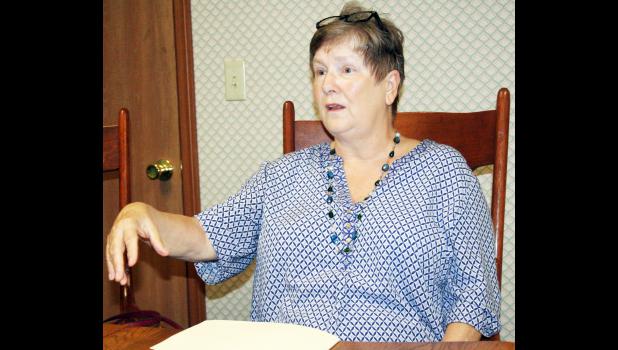
Hutchins, Pyle reflect on marathon legislative session

This year’s session of the Kansas Legislature was the longest in history — 113 days — and regardless of whether goals set for the year by many legislators were met, many of them were only too happy to get it overwith.
Count Rep. Becky Hutchins (R-Holton) among them.
“I’ve served in 12 sessions, and this one was, by far, the toughest one I’ve ever seen,” Hutchins said Friday. “I was wearing down.”
Ditto Sen. Dennis Pyle (R-Hiawatha).
“I was just glad to get home,” Pyle said. “It will be interesting to see what the governor comes out with and what direction he takes going into next year’s session.”
The 2015 session of the Kansas Legislature — marked at the end by all-night sessions with a focus on passing a budget that included tax increases designed to cut a large budget shortfall for the year — was capped by Gov. Sam Brownback’s signature on legislation that he said did not amount to a tax increase.
Both Hutchins and Pyle said they would have approached the tax increase — which raised the state’s base sales tax rate from 6.15 percent to 6.5 percent — in a different way, but they also noted it was needed to avert a situation that would have put hundreds of state employees out of work and underfunded the state’s schools.
“If we didn’t get the 63 votes by Sunday, then the pink slips were going to go out to the people who were furloughed or out of a job on Monday,” Hutchins said. “Did I particularly like that? No, but I voted for the package, and like I said, I wasn’t willing to take that chance that we would default and not be able to pay our schools.”
Critics of Brownback have attributed the budget shortfall to personal and business tax cuts enacted by the Legislature in 2012 and 2013 — Brownback said those measures were meant to stimulate the economy, but critics say they were detrimental to the state’s lower classes. None of those 2012 and 2013 cuts were restored this year, it was reported.
“There’s quite a faction that wanted to deal with some small business issues, and go back and address that. But the governor said he would veto that, and I think that was a big driver,” Pyle said. “As hard as he drew the line this year, I don’t see him moving that way next year unless revenues just totally go into the basement.”
Hutchins agreed that discussion of the 2012 and 2013 cuts was not off the table for the 2016 session.
“That issue is not gone, and it will be back in the next session, if our revenues don’t come in, if we have a verdict from the Supreme Court about funding for education,” she said. “We got through this session to pay the bills, and all of that will be re-addressed, I’m sure.”
Hutchins said it was “factions” that caused a great deal of the end-of-session gridlock, opining that there were four distinct groups working in the Legislature this year.
“The first group is the one that hates Brownback and wants him to fail, and so they would sit on their hands and not try to find some kind of solution or agreement,” she said. “Then you have the group that signed a tax pledge somewhere, and they’re not going to vote for any tax, at any time, for anything. Then you have the third group who wouldn’t vote for anything unless it fixed the income plan that they had passed in 2012.”
Hutchins said she was part of the fourth group — one that “just wanted to find a solution and go home.” And even though finding the solution agreed upon by the majority of legislators in the end took a long time, she noted that it had to be done, lest “a constitutional crisis” arise.
“When I took my oath, I swore to uphold the Kansas Constitution, and that says we have to balance the budget before we go home,” she said. “If we were like the federal government, we’d just keep spending more money that we don’t have and just keep putting our state in more and more debt.”
Pyle also said that much of what was accomplished during this year’s session stemmed from “demands” Brownback made in this year’s State of the State address.
“He pretty much drove the session this year by compelling the Legislature to meet those demands,” Pyle said of Brownback. “He got the (school funding) block grant through, he got the elections bill. The only thing I didn’t see, I don’t believe he got the judicial reform he was talking about. But he did manage to get the consumption tax increases through, and I think that was one of his biggest issues.”
The “consumption tax,” included in the sales tax increase, amounted to a 50-cents-a-pack hike in the amount of sales taxes paid on cigarettes. Brownback had also sought an increase in the amount of taxes paid on the sale of alcoholic beverages, but that did not go through, and Hutchins said that most Kansans surveyed were not in favor of it, as opposed to the cigarette tax increase.
A bill changing the state’s alcohol laws, she said, pointed to another problem that is only worsening at the legislative level — the bundling of bills. Many parts of that bill, she said, would have helped Holton, and even though the bill passed, she voted against it because there was one part of the bill she felt strongly about — the serving of alcoholic beverages at the state capitol, which she opposed.
“We thought we were accomplishing something by limiting bundling,” she said.
As for working past the usual 90 days alloted for a legislative session, Hutchins was one of a few lawmakers who opted not to be paid for staying in Topeka later than usual “just to show that we weren’t down there twiddling our thumbs.” (Rep. Randy Garber of Sabetha, who represents the northern part of Jackson County, also opted not to be paid after the 90 days were up.)
Both Hutchins and Pyle said they expect a shorter session in 2016.
“If we don’t get a really bad decision from the Kansas Supreme Court on education funding and everything else, where we can manage the budget, we should be out in 80 days next year, to make up for the 113 days we had this session,” Hutchins said.
