
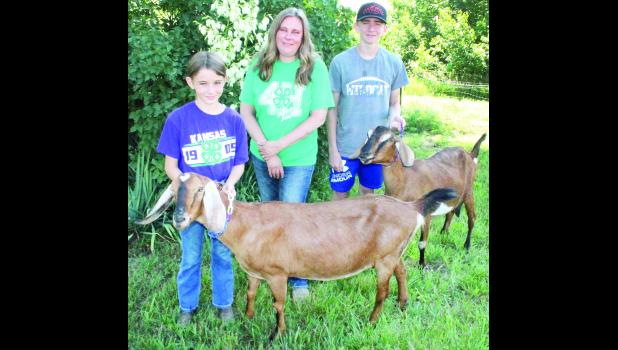
Terry family learns life lessons from raising dairy goats

Not all dairy producers work with cattle, as the Jeff and Yvonne Terry family of rural Holton can attest.
The Terrys and their children, 14-year-old Tucker and nine-year-old Carly, work with Nubian dairy goats to produce milk that can be used to make cheese, yogurt, ice cream and other dairy products — or just for enjoying a cool glass of milk on a hot summer’s day.
But as Yvonne notes, the idea of drinking goat’s milk may not go well with some people — at first.
“Some people are like, eww, gross, goat’s milk. Nobody wants to try it, and then they do, and they’re like, hey, this is actually really good,” she said. “People are pleasantly surprised… Some people like it better than cow’s milk.”
And if goat’s milk is processed properly, there’s not much of a difference in taste between that and cow’s milk, Yvonne said.
“A lot of people who are lactose intolerant can drink goat’s milk without any problems,” she said. “There’s a different kind of protein in goat’s milk, and it’s actually the only milk that any mammal can sustain itself on.”
The Terry family got started with dairy goats about six years ago, when Tucker, who had just started his 4-H years with the Soldier Boosters club, was looking for a project and voiced a desire to raise meat goats.
“It was something I could sell at the livestock auction that was more controllable than a steer,” Tucker said.
However, Yvonne said she steered Tucker into working with dairy goats, noting that she had always wanted to live on a dairy farm.
“This was kind of a way to kill two birds with one stone,” she said. “He got to show goats, and I got a dairy.”
Tucker and Carly, also a Soldier Booster, both got into working with dairy goats and showing them at the Jackson County Fair. Last year, Carly showed the reserve grand champion doe and Tucker was named reserve grand champion in intermediate showmanship.
The Terrys currently have a herd of nine Nubian dairy goats on their 10-acre farm southwest of Holton, and that includes seven does and two “breeding bucks.” The does are milked every morning, and Yvonne said each of the does can produce about a gallon of milk per day.
“We use a milking machine,” she said. “They’re trained to know the order they’re supposed to be milked in, and they get up on the milk stand to be milked. Sometimes Carly helps me.”
Once the milk is obtained from the does, it goes straight into the freezer “for two or three hours,” which Yvonne says is “important for the taste.” Freezing raw goat’s milk doesn’t affect its nutritional profile or destroy enzymes or probiotics, and it also delays the growth of naturally-occurring bacteria.
To read the rest of the article, please subscribe to The Holton Recorder.
