
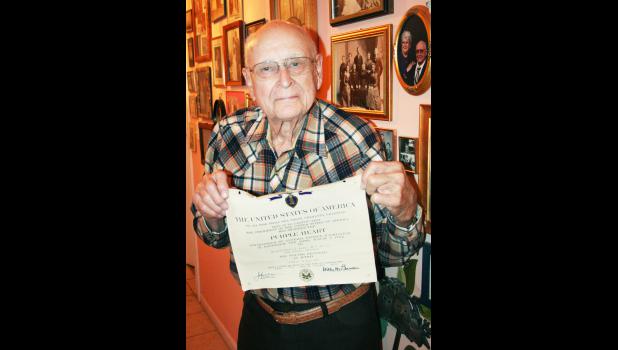
Purple Heart Profiles: Robert Stapel

Editor’s note: This is the 10th in a series of stories about past and present Jackson County residents who earned the Purple Heart Medal, which is awarded to military personnel wounded or killed in the line of duty.
The names of those profiled in these stories will be placed on a special monument for Purple Heart Medal recipients to be built soon in Holton’s Linscott Park.
———
On July 24, 1953, Private Robert H. Stapel, a native of Jackson County serving in the U.S. Army, was on ground patrol in Korea during that divided country’s war when a mortar shell exploded in the trench he was standing in, wounding him.
“It was only 15 to 20 feet away,” said Stapel, who earned the Purple Heart Medal for his combat wound. “It knocked me down flat in the trench. But you know, I didn’t feel anything, so I thought, well, I’m all right.”
Then he got up and noticed blood falling from his lips, where a piece of shrapnel had flown and split them.
“The blood was just pouring down into the bottom of the trench,” said Stapel, who still has the last remnants of a scar from the lip wound visible on his face.
Stapel’s lips weren’t the only part of his body that were impacted by shrapnel, as a piece had hit him in the back and gotten lodged in his ribs. Luckily, he said, it doesn’t bother him.
Now living west of Meriden in Jefferson County, Stapel said he’s proud to be among those whose names will be featured on the new monument to be built in Holton’s Linscott Park honoring Jackson County’s Purple Heart recipients.
He was born to Claude and Lucretia Stapel and raised on a family farm located along Marple Road (now U4 Road), “just barely in Jackson County.” He attended school in the Hoyt area, graduating from Hoyt High School in 1950.
After high school, he met and married Twila June Kinkade and farmed with his father, until November 1952. At that time, he said, he was drafted into the U.S. Army. and shipped off to Camp Roberts in California for basic training.
Stapel arrived in Korea in early 1953 and was attached to the Army’s 187th Airborne Division, where he served as an infantry rifleman, or a “ground pounder,” as they were known. He was on patrol in a trench on July 24 of that year when the mortar landed in the trench and exploded, slicing his lips and sending him to a medic for treatment.
“I got back as far as one of the tents,” he said. “If I was injured worse, I would have probably gone all the way back to the hospital.”
Three days after the air attack that injured him, on July 27, North and South Korea signed the armistice that put an end — albeit not a permanent one — to hostilities between the two nations. Meanwhile, Stapel was letting the medic work on his lip, sewing up the wound.
“That medic did a wonderful job of putting it back together,” he said.
As for the piece of shrapnel that got embedded in his back, it wasn’t discovered until a few years later when a doctor was checking him for kidney stones.
“They ran me through the X-ray, and they said, ‘We can see them, but you’ve got something else, and it’s not where your kidney’s at,’” Stapel said. “It was just a little piece of shrapnel that they didn’t get all dug out.”
After two weeks in the infirmary, Stapel was released to return to his unit, which had decided to go back to its headquarters in Japan now that armed hostilities had ceased. He was invited to return with the 187th Airborne to Japan — on one condition.
“They told me I’d have to go to jump school, and I said no to that!” he said.
Instead, Stapel stayed in Korea and was shuttled from division to division, serving as the driver for the company commander in one unit and serving on the Honor Guard in another. It was in the latter unit, he said, in which he got to see Syngman Rhee, the first president of South Korea.
“He was the big man at the time,” Stapel said of Rhee.
Eventually, he was shipped back to Fort Lewis, Wash., then traveled by train to Camp Carson, Colo., for his discharge from the Army at the rank of sergeant. He returned to the Hoyt area to go back to farming with his father and to start a family with Twila; they would go on to raise two daughters and a son.
In 1958, Stapel took a job at the Dupont plant in Topeka, working there for 34 years. After his retirement from Dupont, he went back to farming, taking care of farmland in Jackson and Jefferson counties, and he and Twila traveled to several locations in Europe and Africa.
He and Twila had been married for 63 years when she succumbed to pancreatic cancer last July. Fortunately, he said, doesn’t have to worry about getting older alone.
“All three of my kids live within 10 minutes of here,” Stapel said. “I’m a real lucky man.”
