
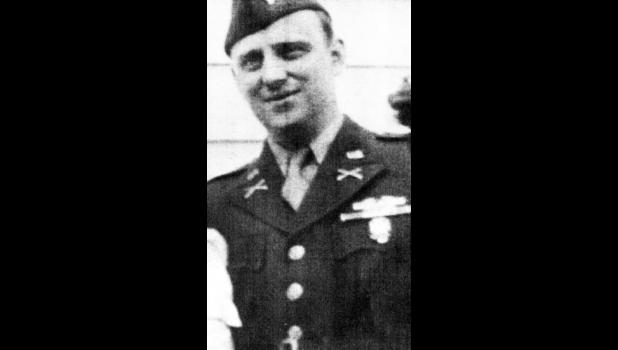
Manuel wounded in Normandy invasion

Editor’s note: This is the 26th in a series of stories about past and present Jackson County residents who earned the Purple Heart Medal, which is awarded to military personnel wounded or killed in the line of duty.
The names of those profiled in these stories will be placed on a special monument for Purple Heart Medal recipients to be built soon in Holton’s Linscott Park.
———
Milton Manuel had only been in combat for 10 days after arriving in Europe on Omaha Beach — one day after the decisive “D-Day” battle that changed the course of World War II — when a German shell exploded near him, knocking him down and leaving doctors concerned whether he would ever walk again.
Although Manuel’s story — related by his sister, Floye Knouft of Holton — ended on a somewhat happier note, it took him years to summon the courage to talk about his wartime experiences.
Born March 20, 1919, to Harley and Stella Kroth Manuel, near Holton, Milton Manuel was raised on a farm in far western Jackson County, near Buck’s Grove Methodist Church, and decided as a teenager that he wanted to go to college, making him the first member of his family to do so.
In the fall of 1937, he started off for Kansas State Agricultural College with only $25 in his pocket and a borrowed suitcase. Four years later, he had a college degree, an Army commission as a lieutenant and a young wife, the former Alice Grandfield, whom he married on her 20th birthday.
Manuel was assigned as a platoon leader of Company H, 38th Regiment, 2nd Infantry Division, and was initially stationed at Fort Sam Houston in Texas. In March of 1942, he was promoted to first lieutenant, assigned to battalion staff as plans officer and commander of Headquarters Company and moved to Camp McCoy in Wisconsin.
The 2nd Division received its overseas orders in the fall of 1943, and Manuel’s unit was stationed in Northern Ireland, concentrating on land tactics for the upcoming invasion of France. Six weeks before D-Day, the division was moved to southern Wales, and Manuel learned of the Normandy invasion plans in the weeks leading up to that invasion.
The division spent the day of the invasion — June 6, 1944 — in the English Channel, and Manuel and his division landed at Omaha Beach the next day. Their first offensive action was to attack the town of Treviers, which was two miles from the beach and occupied by the Germans as a transportation hub, on June 9.
However, due to miscommunications between companies in the division, Manuel’s battalion needed an officer to travel between companies with orders, and Manuel performed that task. He was required to wade across a river several times with orders, but was not injured during the battle, which ended with the Allies securing the town the next day.
The battalion then moved to Cerisy de Foret in an attempt to retake St. Lo, which it did since an expected German counterattack never happened. The next objective was to take a heavily-fortified hill where German soldiers could see all the way to the Normandy beaches.
June 15 saw the battalion taking the right flank but coming under heavy fire from the Germans, and Manuel was ordered to take a “runner” to find another company’s commander, who had been reported missing. He was also told that if the commander was lost, he would take command of the company.
Manuel and the runner found the other company, and he took command of it after a junior officer informed him that the commander was still missing. But not long afterward, while Manuel was checking the layout of the position and the condition of the platoons, an enemy shell hit a tree and exploded directly overhead, knocking him to the ground and instantly killing the soldier beside him.
He crawled under a hedgerow to avoid the shelling and noted that he had shrapnel in his right shoulder and a shattered left ankle. After using his belt and hunting knife to make a tourniquet for his leg, he was eventually carried to an English military hospital, where a long healing process would begin.
Manuel would spend the next six months lying on his stomach recuperating from surgery after surgery to repair the damage in his ankle and thighs, and it wasn’t until December when he was able to sit upright in a wheelchair. His shoulder healed fairly quickly, it was noted, but every few years for the rest of his life, shrapnel would work its way to the surface and need to be removed.
Eventually, Manuel made it to a military hospital in California to recover, then transferred to Fort Carson, Colo., for rehabilitation. On July 4, 1945, he was medically retired from the Army at the rank of captain, opting to go home to heal before completing his education.
Manuel earned his Ph.D. in agricultural economics at the University of Minnesota in 1952, then returned to his alma mater — now Kansas State University — to teach in its economics department. He retired from KSU in 1985.
It was not long after his retirement that he returned to Normandy with his wife, son and daughter-in-law, where, after revisiting the place where he’d landed and gotten injured in the heat of battle some 40 years earlier, he would finally open up about his wartime experiences to his family.
Dr. Milton L. Manuel died Wednesday, July 14, 2004, at a Manhattan hospital. He was 85.
