
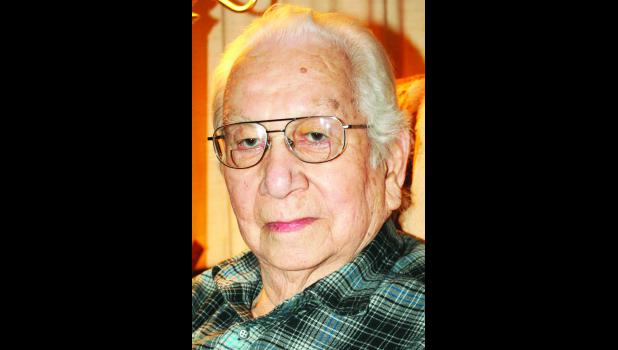
LaClair receives purple heart after WWII injury

Editor’s note: This is the seventh in a series of stories about past and present Jackson County residents who earned the Purple Heart Medal, which is awarded to military personnel wounded or killed in the line of duty.
The names of those profiled in these stories will be placed on a special monument for Purple Heart Medal recipients to be built later this year in Holton’s Linscott Park.
———
Milton LaClair of rural Mayetta was among the second wave of soldiers to hit the beaches of Normandy, France, on June 6, 1944, remembering the experience as a living nightmare of “carnage and death” for Allied forces landing there.
A private at the time with B Company, 18th Infantry, First Division, LaClair would earn a Purple Heart not on the beach that day, but further inland about two months later, according to a Holton Recorder interview from 1994.
Today, LaClair, now in his 90s and retired from the Prairie Band Potawatomi Gaming Commission for more than a decade, lives west of Mayetta on the Potawatomi Reservation with his wife, Rose. He is believed to be the last living Potawatomi resident on the reservation who participated in World War II.
LaClair was 19 when he landed at Omaha Beach on D-Day, the most difficult of the five Allied invasion sites at Normandy to secure. His time on the beach, he said, was either spent flat on his stomach or crouched and trying to run while evading German bullets and shells.
But the Allies were able to push past the Germans on the beaches and make their way about a mile inland by nightfall. It wasn’t long before LaClair — assigned to duty as a “company sniper” — and his unit found themselves in combat with German forces again, trading gunfire back and forth for more than 50 days.
During that time, he said, he and his fellow troops were in almost constant combat with Axis troops, and sleep in the muddy foxholes was a rare commodity. He also saw many of his friends fall victim to a German bullet or shell.
On the day after his 20th birthday, LaClair and the rest of B Company was pulled from combat, given a hot shower and a change of clothes and a hot meal. The next day, however, it was right back to work, fighting the German line.
It was less than two weeks after that when a mortar shell exploded near LaClair, killing his sergeant and wounding him and another man. The explosion blew part of LaClair’s right leg off, below the knee, and he also sustained a deep back wound, but he was able to apply a tourniquet and inject morphine to alleviate the pain before assisting a fellow soldier who was also hurt in the explosion.
For nearly two years, LaClair recuperated in a military hospital, and he eventually lost more of his leg to gangrene. Eventually, he made it back to a hospital in Texas and would later come back to his native northeastern Kansas.
He would later work as a consultant with the National Institute of Alcohol Abuse and Alcoholism, but after retiring from there, he went to work for the Potawatomi Gaming Commission, retiring for good after turning 80. He continues to live on land that was originally part of an allotment to his family in 1902 under the Dawes Act, the controversial legislation that created Indian reservations.
In addition to his Purple Heart Medal, LaClair earned medals for participating in the war and for good conduct. The medals were all stored at the home of his parents, but the home and the medals were lost in a fire in the early 1980s.
But with the help of then-Congressman Jim Slattery, himself a military veteran, LaClair was given new medals to replace the ones that were lost in that fire.
