
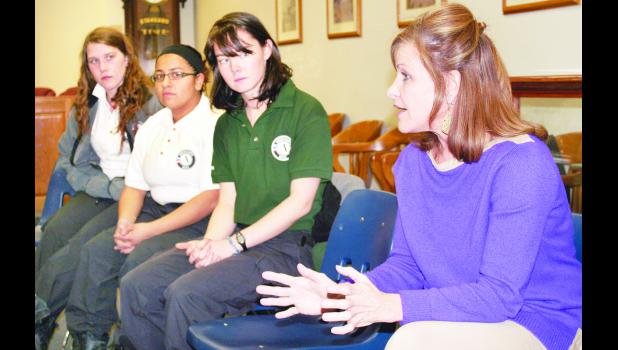
Jenkins in town Tuesday to discuss "common ground"

In an age of hyperpartisan politics — and particularly in a year when some of the top candidates for the presidency appear to be “tapping into the frustration” of their supporters — Lynn Jenkins says she still believes in the concept of “common ground.”
During a visit to Holton City Hall on Tuesday afternoon, the Holton native and Second District U.S. Congresswoman extolled the virtues of cooperation on both sides of the political aisle, even in an election year that “is probably going to be dominated more by politics than policy.”
Jenkins also fielded questions from an audience of about 25 during the “Coffee With Your Congresswoman” stop in her hometown — an audience that included members of the AmeriCorps team currently in Holton for three months. Topics discussed included national security, Obamacare, transportation funding and the upcoming presidential election.
But the topic of top priority during Jenkins’ visit was the people of Kansas — a point she made clear when AmeriCorps team leader Kerry Aszklar of Annapolis, Md., inquired of her about “the best things about this state and this county.”
“Midwesterners are very welcoming,” Jenkins answered, and Aszklar replied that she and the other members of her team have “definitely felt that here.”
Jenkins also encouraged the AmeriCorps team members to stay connected to the legislators in their home districts.
“It’s your job as an American citizen to find out what issues you’re passionate about, and it’s your job to contact your senators and your representatives,” she said. “For most of us, how we feel is how our constituents feel, but sometimes that’s not the case and so we need to hear from our constituents to reconcile the differences. It’s our job to hear what you think.”
From what Jenkins has been hearing, she said the number one topic of concern for most Americans is national security, particularly with the existence of such terrorist groups as the Islamic State. That concern also hits closer to home in light of the possibility of transferring prisoners from the Guantanamo Bay (GTMO) prison in Cuba to the penitentiary at Leavenworth.
“We’ve got nearly 100 of the worst of the worst held in GTMO, and the president is looking to ignore current law that prohibits him from moving them to the United States,” she said. “We’re afraid that we’re going to wake up one day and they’ll be in Leavenworth… We’re afraid that the president is going to use his unilateral authority to do that.”
But a recent town hall meeeting in Leavenworth proved to Jenkins that both sides of the political aisle could find common ground. Jenkins, a Republican, said she and Leavenworth Mayor Lisa Weakley, a Democrat, are both encouraged to see the whole community — and region — pulling together to voice its opposition to any action that would bring GTMO inmates to the area.
Another concern addressed by Jenkins involved the “grandfathering” of health care insurance plans under the Affordable Care Act, or Obamacare, and whether or not that will continue. Holton City Manager Bret Bauer said he was told by a Blue Cross/Blue Shield representative that the city’s existing plans could “stay grandfathered” through 2016, but beyond 2016, things are uncertain.
Jenkins — noting that “if anybody thinks the health care debate is over, they’re just wrong” — continued to stress that Congressional leaders on the Republican side have prepared an alternative health care bill to replace Obamacare, and even Democratic presidential nominees are “looking to shake it up.”
Indeed, she said, Republican leaders have had an alternative plan work its way through Congress, but not completely, because “we never had the votes to override a veto” by President Obama. She added that “most of us can agree that he’s not going to repeal Obamacare” while still in office.
But after Obama vacates the presidency, Jenkins said, many in the Second District — and across the country — will still ask federal lawmakers for a repeal because they “just want to take back control” of their health insurance.
“They want a choice. They want to be able to go with a high deductible if it suits them, if they’re healthy and young. It’s just about not having the federal government telling them what it is and then taxing them if they choose not to participate,” she said.
Jenkins also took note of a comment from Homestead Affordable Housing President and CEO Tom Bishop that when considering having a health care plan “grandfathered” under Obamacare, there is a need to check the cost of “grandfathering” versus the cost of “not grandfathering” due to a recent communication of his own with BC/BS. Taking the latter option, Bishop said, saved him $18,000.
Bishop also asked Jenkins whether Kansas Gov. Sam Brownback’s plan to take “another $35 million out of the transportation budget to keep the state going” would have an impact on how much federal funding Kansas will be given to put toward transporation. Jenkins’ answer: “It can.”
However, she told Bishop she could only have a say in how transportation funding is distributed at the federal level. She also encouraged local and state leaders not to skimp on making sure Kansas has good roads and infrastructure, mainly for the good of economic development and growth.
“We don’t have an ocean, we don’t have a mountain — we just have awesome people,” she said. “We need good infrastructure if we’re going to attract more businesses and convince our young people to stay here. It’s pretty critical.”
As for the upcoming presidential election, Jenkins did not voice her support for any candidate, but said she understood part of why Republican candidate Donald Trump is leading his party. A majority of Republicans are upset with the direction the country is headed, and she said Trump — and, to some degree on the Democratic side, Bernie Sanders — has “tapped into the frustration” that voters are feeling.
“I don’t know that anybody agrees with him on everything,” Jenkins said of Trump. “I certainly don’t.”
Jenkins also reminded those present she sought national office because one political party — the Republicans — had “unfettered power in Washington” but “spent too much money, didn’t get their fiscal house in order and they didn’t balance the budget.” For all political parties involved, she said, the best solution is to find common ground — the focus of the “Problem-Solvers Caucus,” a group she has been involved with since its inception.
“It’s a bipartisan effort,” she said of the Problem-Solvers Caucus. “They try to get to know each other as human beings and find common ground. And there is common ground that can be found, even when we’ve got deep partisan divisions in America.”
