
Heights launches weather balloon

A group of Jackson Heights science students took their third trip into the upper reaches of the atmosphere on Monday, traveling higher than two previous trips had taken them before — and yet they never left the ground.
That morning, students at Jackson Heights High School launched a helium-filled weather balloon carrying a handful of science experiments up, up and away to find out just how much of an effect the high altitudes would have on them. The balloon went to the edge of space — nearly 18 1/2 miles up — before bursting, its payload floating back to earth less than six miles away from the school.
“It got up to about 97,155 feet this time,” said Vern Andrews, Jackson Heights technology director. “We were shooting for 100,000 feet. It is possible to go higher than that, but we haven’t attempted to go higher than that because we’d have to have fewer experiments on board, for less weight.”
And as with previous trips into the sky, the results of the experiments were mixed, with Andrews noting that students are still analyzing data from this particular trip to “the edge of space.”
Wednesday’s launch marked the third such event for Jackson Heights, as well as the school’s first participation in the Global Space Balloon Challenge, described by Andrews as a celebration of “an age where anyone can reach the edge of space for a few hundred dollars and a few weekends of work.” A total of 293 teams from 47 countries around the world participated in the challenge, it was reported.
“By providing a specified launch window and central online platform, the Challenge enables teams to showcase their unique cultures while working together to educate the next generation and push the boundaries of what is technologically feasible,” Andrews said.
For JHHS students, the balloon trip provided an opportunity to ask scientific questions about what might happen in certain high-altitude situations where levels of air pressure and radiation are drastically different from levels on the ground. Monday’s trip topped the first trip’s maximum height of 96,300 feet and easily bested the second trip’s peak of 67,920 feet, it was reported.
But unlike the previous launches, Monday’s balloon trip didn’t end far from the school. The 2012 launch ended in a field near Nevada in southwest Missouri, some 125 nautical miles away from Holton, while the 2013 balloon trip came to an end in the Kansas City suburb of Independence, Mo.
This time around, the balloon never went more than 15 miles from the point of launching. Andrews said the balloon landed in the vicinity of K Road and 286th Road, or 5.9 miles away from the school.
But while it was up, he noted that at least one of the experiments produced some expected results. That particular experiment, utilizing a tone generator and an iPod to log decibel levels, focused on whether higher or lower sound frequencies go away first as the atmosphere thins out, with Andrews stating that the results showed “it’s much quieter up in near-space.”
“Background noise pretty much disappears at about 70,000 feet,” he said. “At about 90,000 feet, there was a huge difference, with all the frequencies disappearing in volume. The upper two frequencies disappeared, and the other three were greatly reduced.”
Another experiment was repeated from the first two balloon trips, but with a different emphasis. In the earlier trip, students wanted to find out whether blood would actually “boil” at an altitude of at least 60,000 feet, but in each case, the results went undocumented by a camera placed into the box of experiments.
On this trip, students wanted to see what happens when air pressure is removed from the liquid after a cork pops out of a vial at 90,000 feet up. In some respects, that experiment was a success, Andrews said.
“The cork didn’t pop off like we had hoped,” he said. “But it did release the pressure, and it did expand substantially in the test tube. We had about two inches of liquid, and it expanded by about half an inch, so we could tell the lack of pressure was having an effect on it. We didn’t really capture a boil like we’d hoped. We’d have to modify the experiment a little more to capture that better.”
Other experiments involved visual documentation of the trip. A camera was placed inside the experiment box to take photos of the area every 30 seconds, and a video camera also was pointed upward “to see what is happening to the balloon as it goes up and also capture the balloon bursting.”
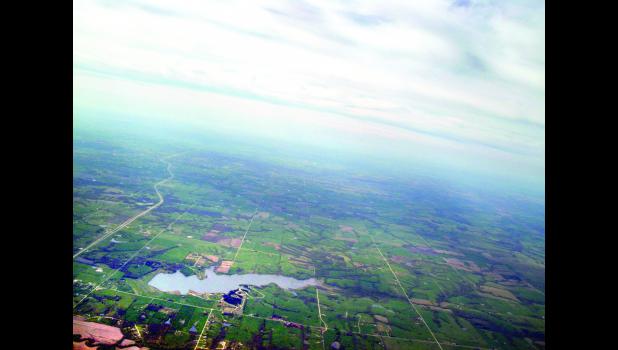
“It was a cloudy day, so the photography was OK,” Andrews said. One of the photos was taken from an altitude of about 10,000 feet and showed Holton and Lake Perry in one shot, he added.
A GPS monitor was also placed inside the experiment box so that Andrews and others could track the box’s flight and descent. It was projected that the box would burst over Wetmore and land between Wetmore and Sabetha, but the burst reportedly occurred a few miles south of Wetmore at a location just north of 278th Road between M and N roads.
The previous two balloon launches involved mainly junior high science students, but this time, Andrews said the experiments were devised by students in Gary Feldkamp’s high school science class. He added that for students participating in the launch, there was more than just the “wow” factor involved.
“The process of flying a high altitude balloon all the way to space and bringing it back not only teaches the basics of science and engineering, but also teaches critical lessons of teamwork and organization, essential for any career path,” Andrews said.
